Showing posts with label veggies. Show all posts
Showing posts with label veggies. Show all posts
Friday, February 22, 2013

Wednesday, January 9, 2013
Happy New Year
Happy New Year, friends and family. Although I have not written much lately, things have been happening here in the Healing Kitchen- albeit slow and sporadic for the past few months. I have to admit, I have not been cooking nor eating as well as I could be- my diet has pretty much consisted of (gluten free) toast, and handfuls of dried fruit and nuts for much too long. But, with a new year comes new resolve, and I hope to be back in the kitchen whipping up gluten free goodies, and heavy on the raw vegan for the next few months.
I started a container garden right after Christmas, and it is going strong. I am happy and surprised to see how quickly things are growing. For veggies, I have planted kale, lettuce, beets, shallots, and onion. For herbs: Thai basil, cilantro, parsley, and dill.


So far, I love the Grow Box. You fill the bottom with water, and it draws up water as needed. So I do not need to water every day. The smaller pots I do need to water every day.
I am now keeping the watering can in my bathroom. When I turn on the shower in the morning, I put the watering can under the bath faucet until the water heats up to shower temperature. That way all that cold water is not just going down the drain, and I have water for my balcony plants. So far, so good!
I started a container garden right after Christmas, and it is going strong. I am happy and surprised to see how quickly things are growing. For veggies, I have planted kale, lettuce, beets, shallots, and onion. For herbs: Thai basil, cilantro, parsley, and dill.

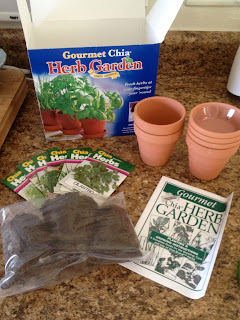
Christmas gift- Chia herb garden!

Starting seeds

Another gift- a "grow box" I believe this is similar to an Earth Box.
This is upon assembly.

Seeds planted

Herbs growing

Seeds sprouting!
I am now keeping the watering can in my bathroom. When I turn on the shower in the morning, I put the watering can under the bath faucet until the water heats up to shower temperature. That way all that cold water is not just going down the drain, and I have water for my balcony plants. So far, so good!
Tuesday, August 2, 2011
How to read produce sticker codes
Did you know that those little stickers on your fruit actually mean something? Surprise, they are not just for grocery inventory- they contain important information about the produce, such as where and how it was grown.
 I probably should have turned this sticker right-side-up for the photo. Oops :)
When shopping, one quick glance at the sticker tells you whether the produce is organic, conventional, or genetically modified.
Here is the basic information to remember:
In the photo above, the label actually shows that the apple is certified organic, Cameo, and that it was grown in the USA. Some stickers will also show what state the produce comes from. But not all stickers have all of that information right on the label. Some only have the code.
So, if you are a data geek like me, know that you can input the 4-digit code in this database, to find out even more information about the apple. You can see below that it tells you the variety, botanical name, size, and growing region. This actually isn't the best example- some entries have more information than others (click on photo to enlarge).
 The pluot below has a 9 in front of the 4-digit code, which indicates that it was grown organically. Again- that's a quick and easy way to tell if something is (or is not) organic when you are in the grocery store.


Have fun and happy shopping!
ADDITION: The 9 identifies items that are Certified Organic by the USDA/EU. Some produce may be grown without chemicals or pesticides, but for various reasons may not be certified organic. Ask your local grower for more information about how their produce is grown- they are the best ones to answer your questions. Ask yourself what is most important to you in the foods you consume. It may be that you can find locally grown produce that meets (or nearly meets) your needs even if it is not USDA/EU Certified Organic (which includes a lot more criteria than just grown without chemical pesticides).

When shopping, one quick glance at the sticker tells you whether the produce is organic, conventional, or genetically modified.
Here is the basic information to remember:
- The 4-digit code tells you what the produce is. For example: 3065 is a cameo apple
- Organic produce adds the number 9 to the front of that code. For example: 93065 is an organic cameo apple
- Genetically modified produce adds the number 8 in front of the code. For example: 83065 would be a cameo apple that has been genetically modified.
In the photo above, the label actually shows that the apple is certified organic, Cameo, and that it was grown in the USA. Some stickers will also show what state the produce comes from. But not all stickers have all of that information right on the label. Some only have the code.
So, if you are a data geek like me, know that you can input the 4-digit code in this database, to find out even more information about the apple. You can see below that it tells you the variety, botanical name, size, and growing region. This actually isn't the best example- some entries have more information than others (click on photo to enlarge).


When you input the code in the PMA database, use only the 4-digit code (omit the 9).

Here's another pluot. This one does not have a 9 in front of the 4-digit code, so that means it was grown conventionally. Trust me, you'll get very fast at spotting the 9, and noticing when it is not there. It will become second nature.

Here's another example of when this comes in handy- at the Farmer's Market last week, our favorite organic farmer had some lettuces that he'd brought in from a farm in another state. Those items had labels. They did not begin with a 9. Yet he told us that they were organic. But the label clearly did NOT have a 9, and was only 4-digits. I still bought them, but this tip is good to know if there are certain items, such as the dirty dozen, that you wish to purchase only if they are organic. You cannot always trust the sign in the grocery or what the local produce guy tells you. People make mistakes. If organic is important to you, the 9 on the label is very useful information!
Try this at home if you are curious:) Sometimes I'll buy an item and really like it, but I don't know what variety it is. The database will tell you, and then you know what to look for next time.
The PMA database contains codes for dried fruits, fruits, veggies, herbs and nuts. Pretty cool.
ADDITION: The 9 identifies items that are Certified Organic by the USDA/EU. Some produce may be grown without chemicals or pesticides, but for various reasons may not be certified organic. Ask your local grower for more information about how their produce is grown- they are the best ones to answer your questions. Ask yourself what is most important to you in the foods you consume. It may be that you can find locally grown produce that meets (or nearly meets) your needs even if it is not USDA/EU Certified Organic (which includes a lot more criteria than just grown without chemical pesticides).
Saturday, July 23, 2011
Pink eyed peas
What do you get if you cross:
Pink Eyed Peas! Hahahahahaha.
OK, I couldn't help it.
On to the real post.
About actual pink-eyed peas.
I was fortunate enough to be in the neighborhood of Beasley Farms a few weeks ago. Beasley Farm is not certified organic, but they practice "sustainable farming methods" and most important to me- they do not use pesticides. I try to stop by their farm stand any time I'm in the area.
This time, I purchased several kinds of Southern peas. Now, I've never cooked Southern peas before, and I had NO idea what to do with them, but was willing to try to figure it out.
Some of the peas were shelled, some were still in the shell. I took some of both.
The owner asked "Are you sure? Those aren't shelled yet" I said "Sure! I'll shell them." (as if I had any idea what I was talking about) Ha!
Lesson learned: When the grower asks "Are you sure" you really ought to pay attention.
Here is my first batch of Pink-eyed peas, in the shell. As you have probably surmised, they are like Black-eyed peas, only pink. I thought they tasted a little milder than black-eyed peas. They are very pretty, don't you think?


 |
| Pink |
with
 |
| Black Eyed Peas |
OK, I couldn't help it.
On to the real post.
About actual pink-eyed peas.
I was fortunate enough to be in the neighborhood of Beasley Farms a few weeks ago. Beasley Farm is not certified organic, but they practice "sustainable farming methods" and most important to me- they do not use pesticides. I try to stop by their farm stand any time I'm in the area.
This time, I purchased several kinds of Southern peas. Now, I've never cooked Southern peas before, and I had NO idea what to do with them, but was willing to try to figure it out.
Some of the peas were shelled, some were still in the shell. I took some of both.
The owner asked "Are you sure? Those aren't shelled yet" I said "Sure! I'll shell them." (as if I had any idea what I was talking about) Ha!
Lesson learned: When the grower asks "Are you sure" you really ought to pay attention.
Here is my first batch of Pink-eyed peas, in the shell. As you have probably surmised, they are like Black-eyed peas, only pink. I thought they tasted a little milder than black-eyed peas. They are very pretty, don't you think?

Here is a close up:

Unwashed, unshelled peas- straight from the field that morning!
So, I sat down in front of the TV to shell peas. How hard could it be?
Bailey helped. Bailey loves it when I sit on the floor for a project. He thinks that's his cue to help out.

OK, so it wasn't difficult. But it was tedious. It was fun for about the first 15 minutes. Then I looked at my teeny tiny pile of shelled peas and my huge bag of unshelled peas and it seemed I hadn't gotten anywhere.

It took a long time.
They were yummy. But- next time I'll definitely buy them already shelled. I was glad I didn't buy a whole bushel! Did you know they actually sell produce by the bushel? That's an actual measure. This was half a bushel. She warned me that half a bushel wouldn't be very many peas after they were shelled. That was true- but that was ok. I just wanted to try them, and in the end, I was glad there were not more to shell.
Saturday, June 4, 2011
Allergy friendly asparagus soup
This is a super-easy and delicious soup perfect for summer. Gluten free, dairy free, soy free, corn free... raw and vegan. Minimal ingredients, easy clean up!
 Dairy-Free Creamy Asparagus Soup
Ingredients (adjust to taste)
5-6 stalks fresh, raw asparagus
1/4 cup soaked cashews
1/8 tsp sea salt
Dash ground black pepper
Lemon or lime juice (I used key lime)
Filtered water
Instructions
Break off the tough ends of the asparagus spears where they will snap easily.
Cut off the tips, place them in a small bowl and squeeze lemon or lime juice over them.
Cut remaining spears into pieces and put into blender with the cashews. Add a little water, adjust for the thickness you want. Blend until very smooth.
Taste and add more sea salt or pepper if desired.
Serve in a bowl with the "marinated" tips on top of the soup. Enjoy!


Ingredients (adjust to taste)
5-6 stalks fresh, raw asparagus
1/4 cup soaked cashews
1/8 tsp sea salt
Dash ground black pepper
Lemon or lime juice (I used key lime)
Filtered water
Instructions
Break off the tough ends of the asparagus spears where they will snap easily.
Cut off the tips, place them in a small bowl and squeeze lemon or lime juice over them.
Cut remaining spears into pieces and put into blender with the cashews. Add a little water, adjust for the thickness you want. Blend until very smooth.
Taste and add more sea salt or pepper if desired.
Serve in a bowl with the "marinated" tips on top of the soup. Enjoy!

Monday, May 16, 2011
Raw vegan pesto "pasta" salad
This recipe is straight from the book: Raw Food: A Complete Guide for Every Meal of the Day which my neighbor Joan recently checked out from the local library and I recently checked out from Joan's living room. Heh heh.
I am SO exited about this book! Can you see all of the tabs here?
 These are recipes I can eat! The blue tabs are recipes I can eat as written, the pink tabs are recipes I can eat with minor adaptations. That never happens, even with raw food cookbooks. I think I may have to buy this book!
RAW Tagliatinni with Pesto
 Ingredients
1 zucchini
1 carrot
2 tablespoons pesto (see below)
5 cocktail tomatoes, halved (I omitted these)
5 kalamata olives
Pine Nut and Basil Pesto
1/2 cup pine nuts
1/2 cup olive oil
1 sprig of basil
2 teaspoons sea salt
Lemon juice, to taste (oops, I think I omitted this too)
Blend all pesto ingredients in a blender or mini-food processor. I used the little Oscar food prep food processor.
Spiralize carrot and zucchini (or use a vegetable peeler, or a grater with large holes). Toss pesto with veggies and serve.


This recipe was delicious, and literally took me 5 minutes, start to finish, including measuring ingredients and clean up.
It was definitely good, but next time I make this, I will add a lot more basil, and a little less olive oil.
which my neighbor Joan recently checked out from the local library and I recently checked out from Joan's living room. Heh heh.I am SO exited about this book! Can you see all of the tabs here?

RAW Tagliatinni with Pesto

1 zucchini
1 carrot
2 tablespoons pesto (see below)
5 cocktail tomatoes, halved (I omitted these)
5 kalamata olives
Pine Nut and Basil Pesto
1/2 cup pine nuts
1/2 cup olive oil
1 sprig of basil
2 teaspoons sea salt
Lemon juice, to taste (oops, I think I omitted this too)
Blend all pesto ingredients in a blender or mini-food processor. I used the little Oscar food prep food processor.
Spiralize
carrot and zucchini (or use a vegetable peeler, or a grater with large holes). Toss pesto with veggies and serve.

It was definitely good, but next time I make this, I will add a lot more basil, and a little less olive oil.
Saturday, May 7, 2011
Local Farmers' Market
Today my neighbor Joan and I went to the Farmers' Market. Now that "season" (tourist season, that is) is over, it is slim pickin' at the Farmers' Markets. Many of the markets close for the summer, and those that remain have fewer vendors. The beach market has closed for the summer, and so has the little produce cart around the corner. So we decided to go to the Green Market across the bridge. Bailey agreed.
Joan came over with a green smoothie that happened to match her green ceramic coffee cup:

Bailey loves the farmers' market.

I don't even like tomatoes, but thought these were beautiful

Sprouts, sprouts, sprouts!

Yum!
Joan came over with a green smoothie that happened to match her green ceramic coffee cup:

Bailey loves the farmers' market.

I don't even like tomatoes, but thought these were beautiful

Sprouts, sprouts, sprouts!

Yum!
Subscribe to:
Posts (Atom)